
For years, connecting SMT equipment to factory management systems meant custom middleware, vendor-specific protocols, and integrations that needed rebuilding every time a machine changed. As a result, data often arrived late, lived in silos, or simply wasn’t trusted enough to act on. IPC-CFX was created to fix that — and Europlacer has been part of building it from near the beginning.
What is IPC-CFX?
IPC-CFX — formally known as the Connected Factory Exchange, and standardized under IPC-2591 — is an open industry standard that defines how manufacturing equipment, software, and enterprise systems communicate with one another.
Where previous attempts at factory connectivity addressed only part of the problem, CFX covers all three layers required for machines to genuinely talk to each other: the transport protocol that moves data across the network, the structured message content that gives that data meaning, and the encoding format that makes it readable by any compliant system.
The standard is managed by GEA (Global Electronics Association), the global electronics industry association, and is written and developed by the industry itself — equipment manufacturers, software vendors, and contract manufacturers working together. It is not owned by any single company, and there is no licensing fee for implementation.

The Problem IPC-CFX Was Built to Solve
Before IPC CFX, a typical SMT line told its own story in its own language. A placement machine from one manufacturer, a printer from another, and an AOI from a third each produced data in formats nobody else understood. Connecting them to an MES meant commissioning bespoke integration work, which was expensive, fragile, and had to be repeated whenever software or equipment was updated.
Beyond the budget impact, data is locked inside machines, production managers make decisions on incomplete information. Component traceability becomes a manual exercise. Real-time visibility across a line is something consultants promise and rarely deliver.
However, IPC CFX changes the starting position. As a result, every IPC CFX-compliant machine speaks the same language, teams can reduce that integration work to configuration. Data flows in real time. And because the standard is open, manufacturers avoid dependence on any single vendor’s ecosystem.
How IPC-CFX Works
Transport
IPC-CFX uses AMQP 1.0 (Advanced Message Queuing Protocol) as its communication protocol. AMQP 1.0 is well established in financial services, where it has to move very high volumes of data reliably and securely.
It supports both direct point-to-point communication between endpoints and broker-based publish/subscribe messaging. It does not require manufacturers or integrators to manage complex broker infrastructure. Most implementations need only a network address and an AMQP target.
Content
Rather than defining a fixed message set for each machine class, IPC-CFX organises its content into capability-based topics. A machine implements only the topics that reflect what it actually does — a placement machine implements assembly topics, while one with integrated SPI adds inspection topics on top.
In practice, each machine ends up with a unique IPC-CFX fingerprint built around its capabilities, not a rigid template imposed by its category.
Encoding
Data is encoded in JSON (JavaScript Object Notation), a format that is compact, widely supported across development environments, and straightforward for both humans and systems to read.
Significantly, JSON was chosen to reduce the bandwidth required to transmit messages and to make implementation as accessible as possible for software developers.
IPC-CFX: What It Makes Possible

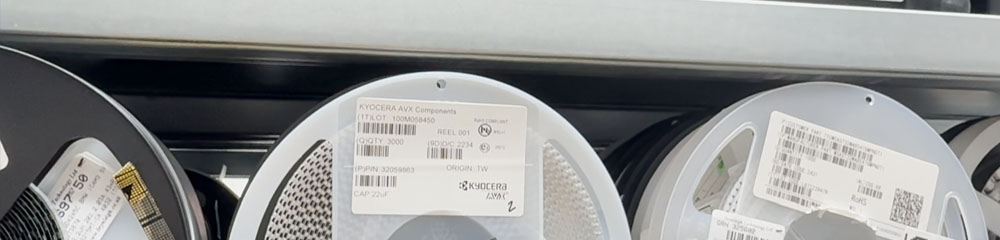


Europlacer and IPC-CFX: Our Role in the Standard

Europlacer is not simply a company that has implemented IPC-CFX. We are one of the earliest machine manufacturers in the world to achieve IPC CFX certification. We are also a major and active contributing member of the IPC CFX A-Team — the working group that develops and refines the standard itself.
That means the proposals Europlacer makes, based on deep knowledge of high-mix production environments, shape how IPC-CFX evolves. When areas of the standard need clarification or extension to reflect real scenarios, Europlacer is at the table. Our implementation is not a bolt-on; it is built directly into the ii-RC machine control software.
In practice, this distinction matters for customers. Working with a manufacturer that helped write the standard means implementation is thorough, behaviour is predictable, and future versions of IPC CFX remain a priority, not an afterthought.
Consequently, all current Europlacer placement machines and the ii-P7 screen printer publish a comprehensive set of IPC CFX events — machine state changes, production starts and stops, component placement data, fault occurrences and clearances, operator login activity, recipe changes, and materials consumption — natively, without additional hardware or middleware.
IPC-CFX Across Europlacer Products
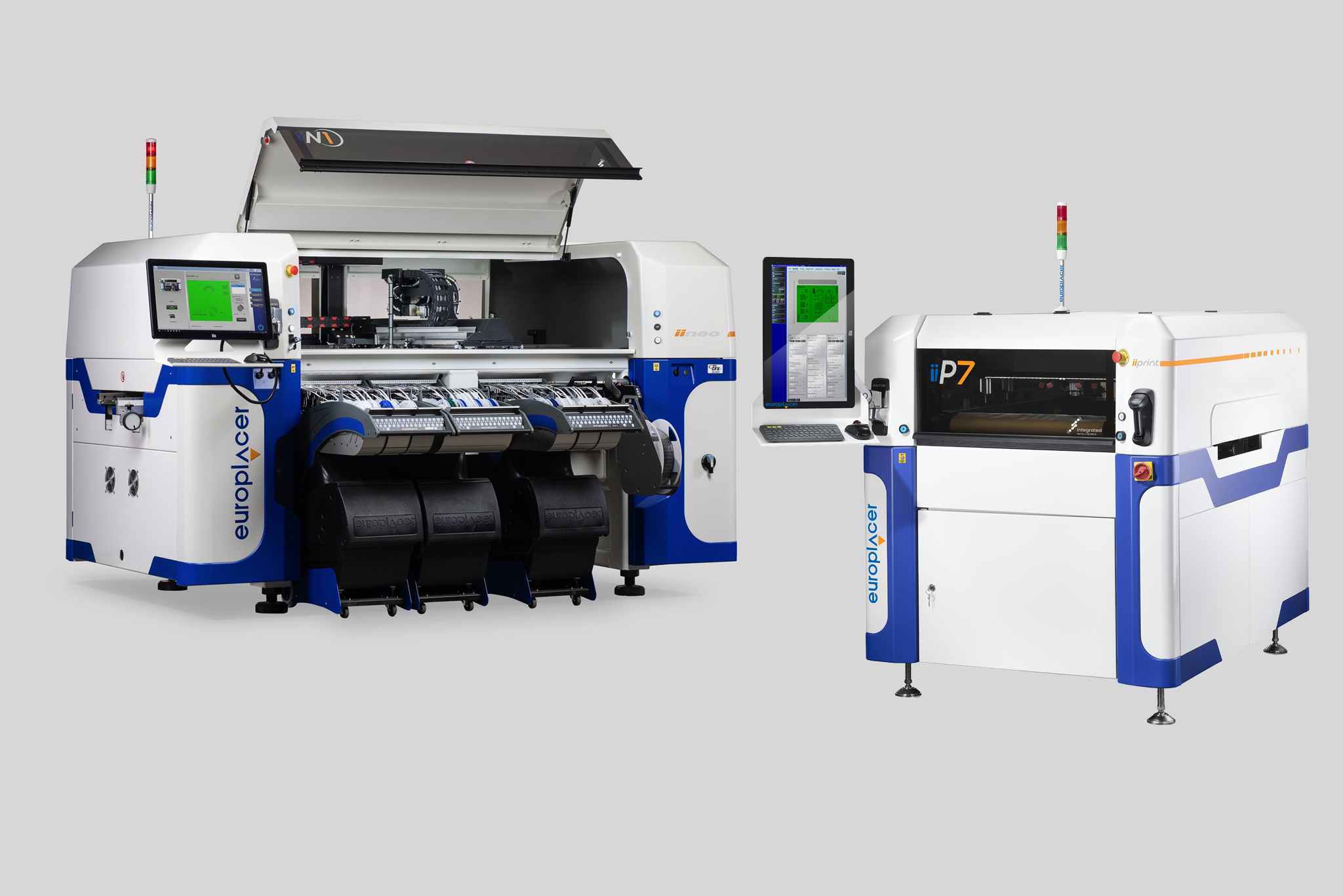
Placement machines and ii-P7 screen printers — All current Europlacer pick-and-place machines and the ii-P7 screen printer support IPC CFX natively via ii-RC software. The full message set covers production traceability, materials management, work-order management, and machine performance reporting.
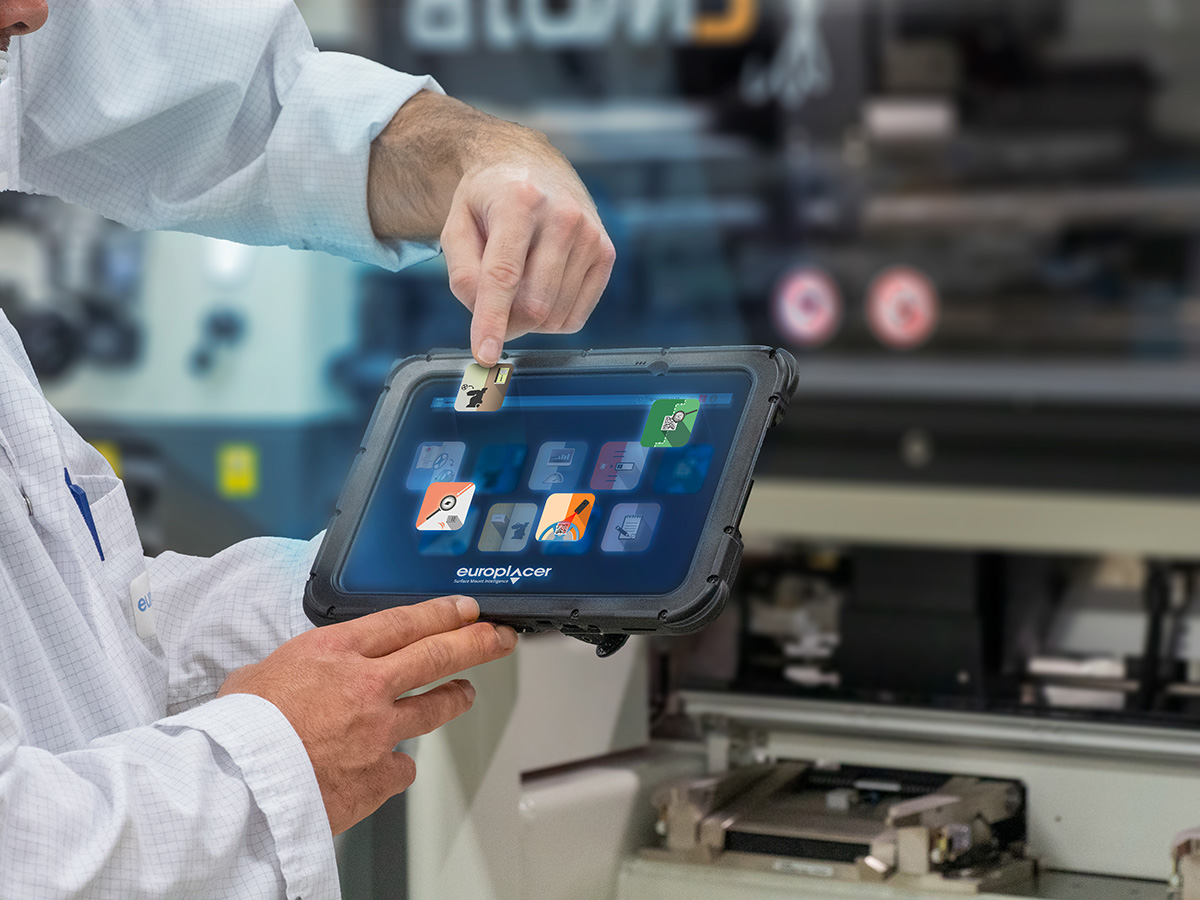
ii-Tab — Europlacer’s mobile production companion uses IPC CFX as its data source, receiving machine events in real time and presenting them to operators on the floor. Setup guidance, work-order status, and materials information all flow through the standard.
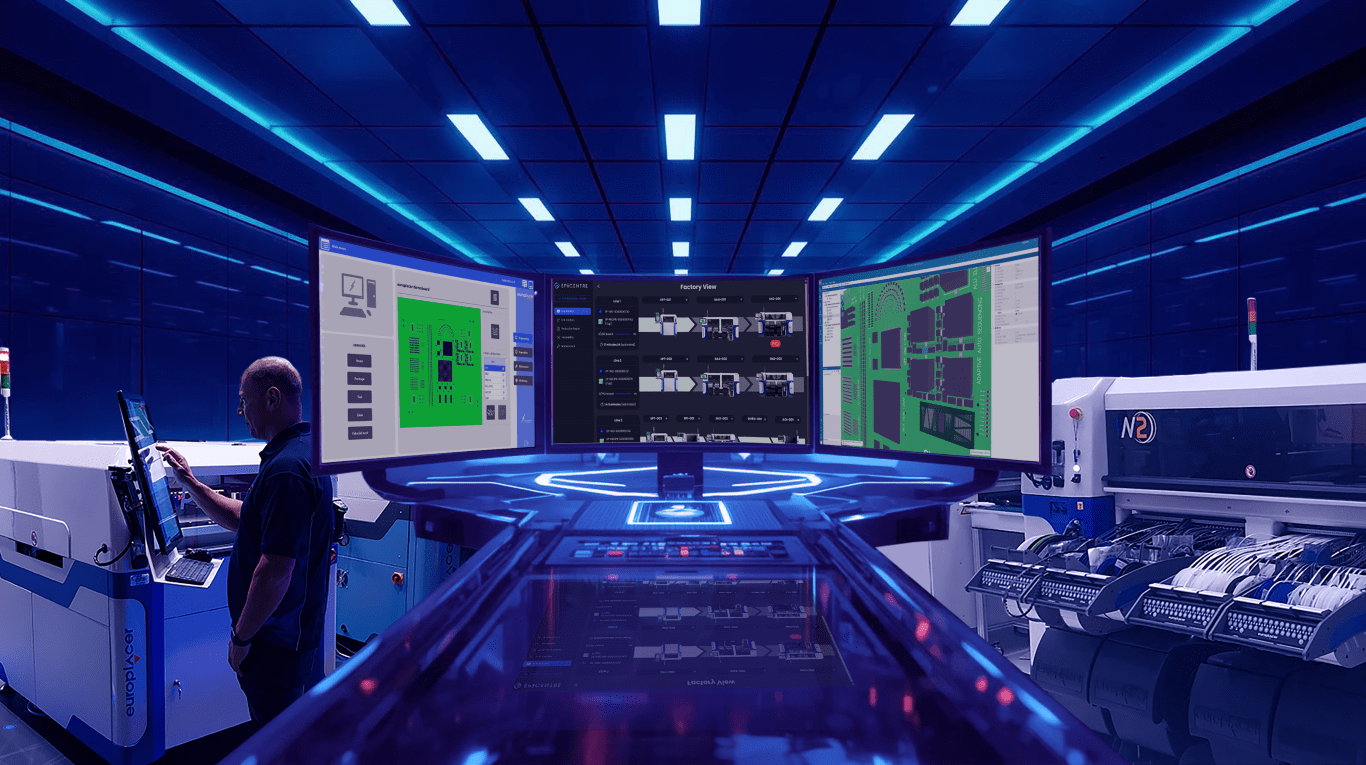
EPiiCENTRE — Europlacer’s factory intelligence platform aggregates IPC CFX data from both Europlacer machines and third-party IPC CFX-compliant equipment to provide line monitoring, OEE analysis, and proactive maintenance across the entire production environment.
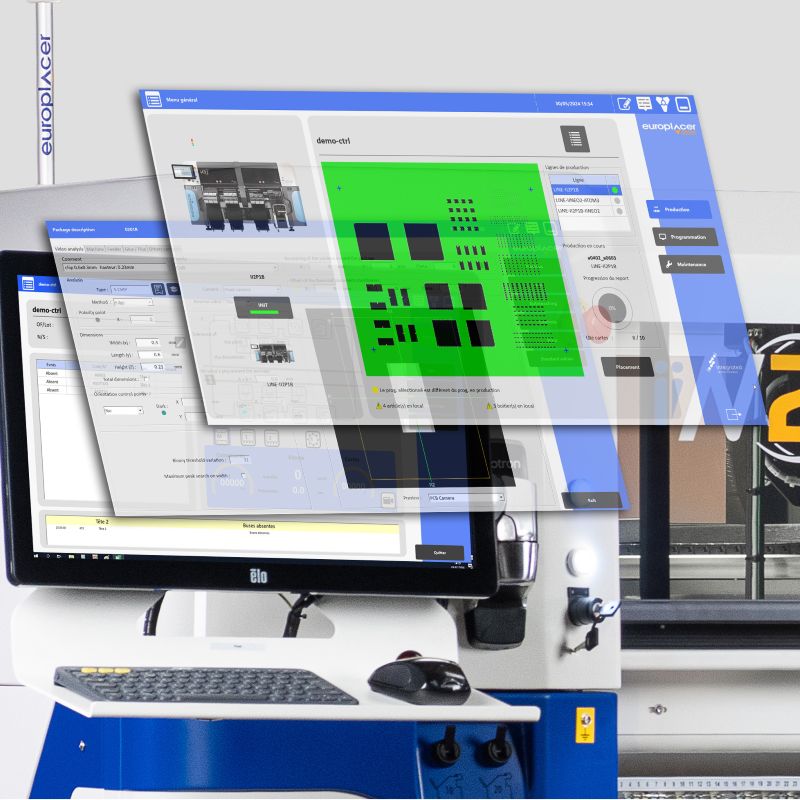
ii-RC software — IPC-CFX is integrated at the core of ii-RC, not added as an option. Configuration is handled through the ii-Configurator, and the system maintains a durable message queue that preserves data integrity even during network interruptions.

