
Why Software Is the Hidden Engine of High Mix SMT Performance
Published: April 24, 2026
In modern electronics manufacturing, the spotlight often falls on machines, placement, accuracy, feeder capacity, component range. These specifications are essential, but in a high‑mix SMT environment, they tell only a fraction of the story.
The real driver of productivity is increasingly invisible: software.
As manufacturing shifts from predictable, stable production toward short cycles, small batches, and constant changes, machines alone cannot ensure performance. Instead, what determines success is the capability to coordinate, align, adapt, and secure every step of the process, something only software can do.
In the world of high-mix, software is not a support function. It is the hidden engine of performance.
Why Machines Alone Can’t Deliver High‑Mix Performance
In traditional high‑volume environments, the machine was the center of gravity. Performance was in line with CPH, accuracy, and overall throughput. But high-mix breaks this logic.
High‑mix production can introduce issues such as more frequent changeovers, unstable flows, more varied product families, diverse component packaging, increased operator interactions, a higher risk of human error and synchronized material management needs.
A placement machine, however advanced, cannot solve organizational, material, and human variability, as it can only perform within the environment in which it operates.
This is where software becomes key.
Software Creates Stability Where High-Mix Creates Variability
High‑mix performance depends on stability; repeatability in a world of constant change, and software provides this stability by:
1. Structuring and securing flows
Changeovers, kitting, feeder preparation, and material validation are critical steps where productivity is lost. As a result, software ensures they happen in sequence, without omissions, errors, or delays.
2. Synchronizing human and technical resources
In high-mix, human contribution plays a major role. Software aligns operators with real needs, avoids overloads, and distributes tasks dynamically.
3. Making change easy to manage
Instead of fighting complexity, software organizes it, ensuring every operation remains coherent with the global process.
4. Providing real, reliable data
In high-mix, small deviations create large performance losses, but software transforms shop‑floor events into useful information that you can act on, preventing drifts and preserve performance.
Machines handle technical variability. Software handles operational, organizational, and environmental variability, the real constraint in high-mix.

Why Traditional SMT Software Is Not Enough
Most SMT software solutions were designed for high‑volume logic:
- rigid workflows
- fixed roles
- linear processes
- reporting rather than real‑time management
- data reconstructed after production
- limited contextualization
- Consistent resource allocation
This design philosophy is at odds with high-mix, where:
- priorities shift fast
- material flow is uneven
- tasks are interdependent
- preparation must be flawless
- changeovers are critical
- human flexibility is essential
- data must be real‑time and trustworthy
To unlock true high‑mix performance, the software must be built around variability, not stability.
Europlacer’s ecosystem offers precisely this.
The Europlacer Software Ecosystem: Designed for High-Mix from the Ground Up
Europlacer does not treat software as a complement to machines. Instead, it treats machines as one element of a coherent ecosystem, where software ensures continuity, integrity, and control.
This vision is not recent.
As early as the late 1980s and early 1990s, Europlacer pioneered:
- intelligent feeders with component identity
- vision-based centering
- electrical component testing during placement
- full traceability through log files
- CAD-compliant, non-modifiable placement programs
Long before “Industry 4.0” existed, Europlacer was already using data to secure placement integrity and improve productivity in demanding sectors such as aerospace and defense.
Today, three pillars structure the Europlacer Ecosystem:
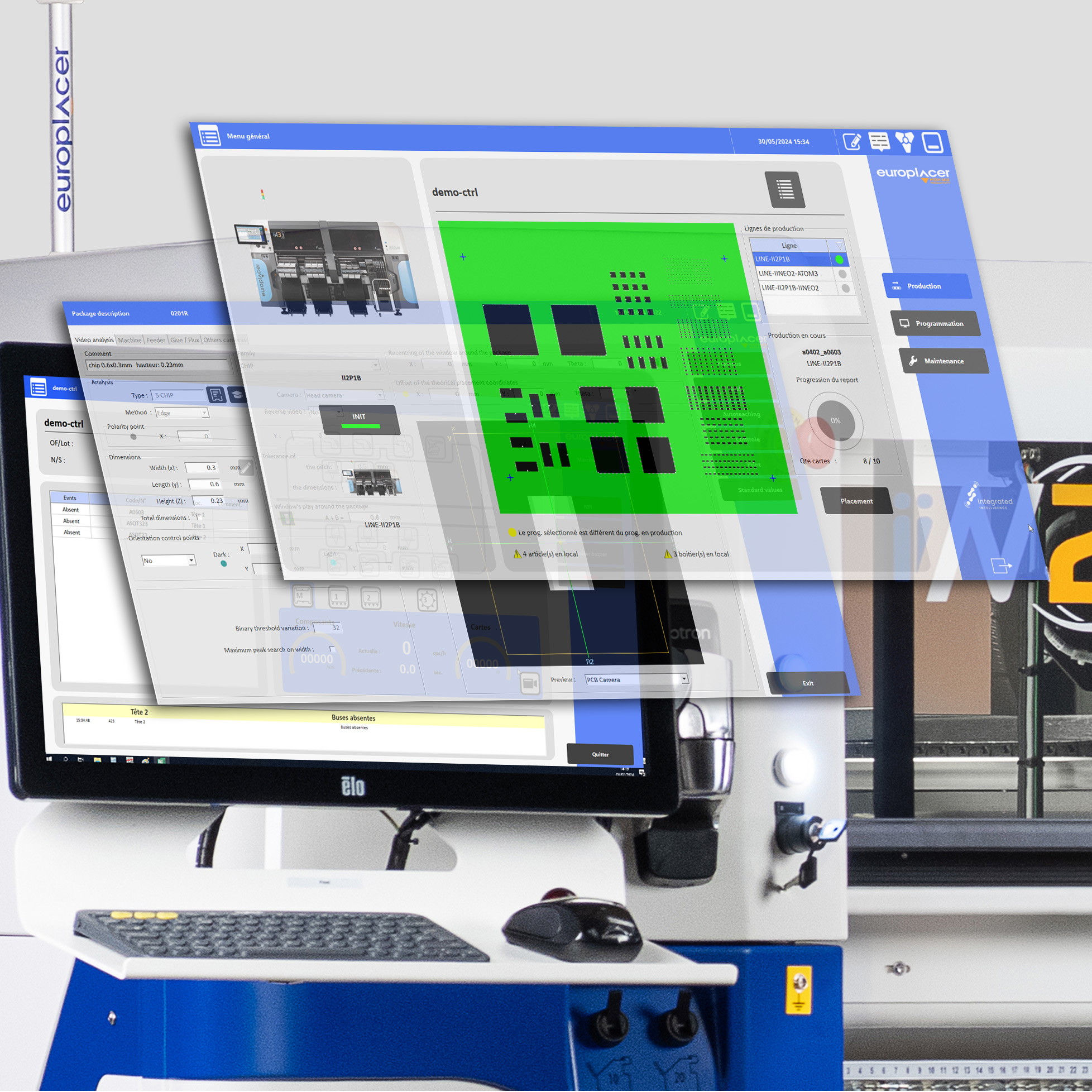
1. ii‑RC — The Core Control Platform
ii‑RC goes far beyond machine control, including orchestrating remote stations, aligning operations across the full process, securing transitions, reducing flow interruptions and ensuring consistent, repeatable changeovers
ii‑RC is the backbone that keeps the process synchronized.
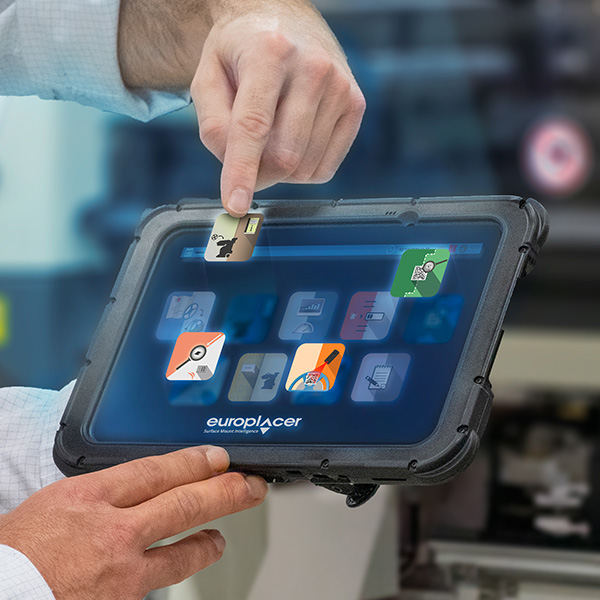
2. ii‑Tab — Bringing Control Directly to the Shop Floor
High-mix performance is highly sensitive to human tasks:
- feeder preparation
- kitting
- component verification
- last-minute changes
ii‑Tab brings software control directly to operators:
- guiding preparation steps
- validating components and feeders
- preventing loading errors
- supporting changeovers in real time
This approach directly echoes Europlacer’s historic error-prevention philosophy: errors are blocked upstream, not fixed downstream.
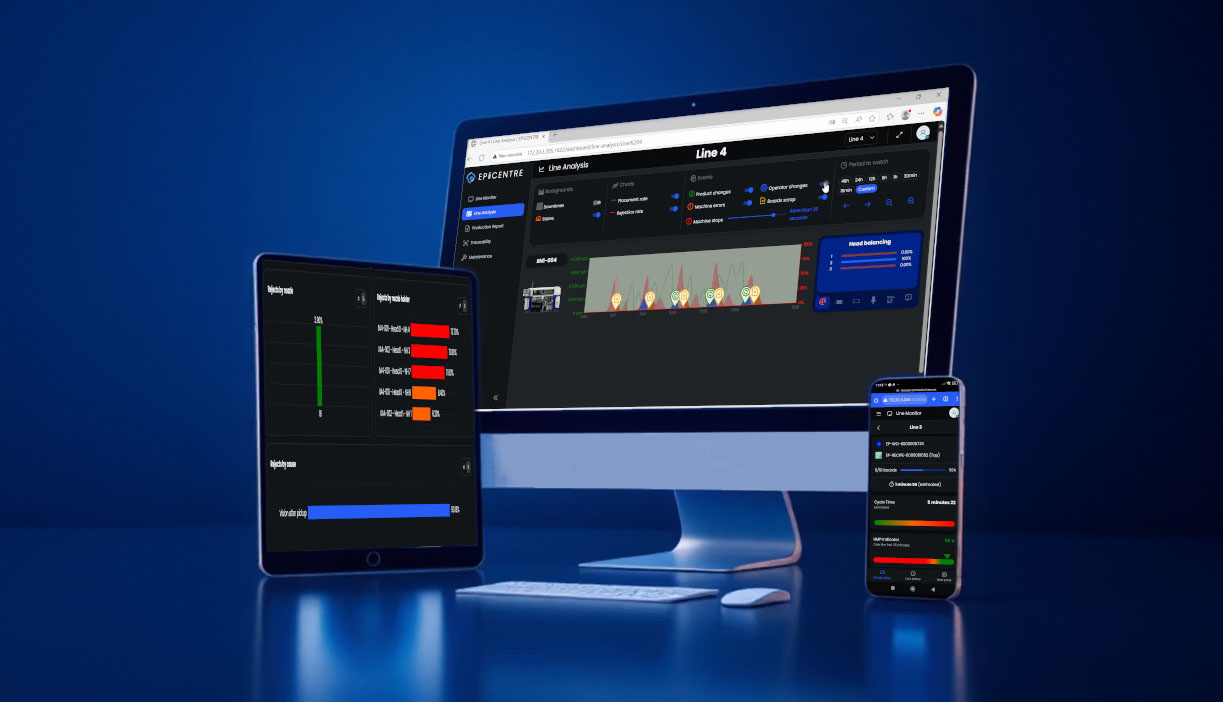
3. EPiiCENTRE — Real‑Time, IPC CFX‑Native Performance Insight
EPiiCENTRE collects clean, contextual, standardized data directly from the process using the IPC‑CFX protocol. In fact, this is not simply just reporting, it’s more a case of real‑time understanding.
EPiiCENTRE enables manufacturers to:
- analyze true process behavior
- detect micro‑imbalances early
- differentiate structural constraints from occasional issues
- drive continuous improvement based on facts
- dynamically adjust resources according to real load
In high‑mix environments, this clarity is essential.
Without reliable data, operators rely on intuition. With EPiiCENTRE, they rely on reality.
Why IPC CFX Matters: Coherence, Comparability, and Trust
In high-mix, approximation is dangerous.
Performance losses rarely come from dramatic failures, they come from an build up of small issues:
- slightly longer setups
- minor material delays
- operator overload
- misaligned priorities
- desynchronized stations
These deviations are almost impossible for staff to see without clean, standardized, time‑aligned data, however Europlacer integrated IPC CFX natively, not as an add‑on. As a result, there are several significant benefits:
- data is not ‘rebuilt’, it is generated live
- events are reliable and comparable
- all stations speak the same language
- decisions are based on facts, not perception
IPC CFX is more than a protocol; it is the foundation for process coherence in high-mix.
Software Unlocks Human Flexibility
High‑mix performance depends not only on machines, but on people, including operators, technicians, material handlers and planners, to name but a few. Europlacer’s software ecosystem frees human resources from rigid task allocation and allows them to operate where real value is needed.
With ii‑Tab and ii‑RC skills become mobile. As a result, workloads can then adapt to real‑time demand, as tasks shift dynamically and operators can help to maintain flow continuity.
In a high‑mix world, the ability to reassign people quickly is a major competitive advantage and only software can enable it.
Software: The Engine behind Modern SMT Performance
It’s important to understand the difference between high-volume and high-mix - in high‑volume environments, machines drove performance within stable conditions, however in high‑mix environments, software drives performance, and ensures job completion in the shortest possible timeframe.
It ensures:
- process stability
- continuous flow
- correct material preparation
- reliable data
- seamless changeovers
- human flexibility
- organizational agility
- synchronized operations
Europlacer’s software ecosystem : ii‑RC, ii‑Tab, EPiiCENTRE, transforms software from just being a support tool into the central nervous system of the production line, providing real-time insight into what is actually happening.
High‑mix manufacturing is complex. Europlacer doesn’t remove the complexity. Instead, it makes it controllable and predictable, and that’s why software is the invisible but essential engine of high‑mix SMT performance.
Conclusion: High‑Mix, Then and Now
High‑mix SMT production is often described as a recent industry challenge but in reality, it has been at the core of certain manufacturing environments for decades. Europlacer is one of the few suppliers for whom high‑mix is not an adaptation of a high‑volume model, but the original operating framework on which its solutions were built.
What has changed is not the existence of high‑mix, but its nature, and today’s high‑mix environment is defined by shorter product lifecycles, tighter delivery windows, increased traceability requirements, higher operator interaction, and growing pressure on material preparation and flow continuity. Variability is no longer occasional, it is permanent, faster, and less predictable, and under these conditions performance can no longer be sustained through machine capability alone.
The limiting factors are now operational: coordination between preparation and production, synchronization of human and technical resources, error‑free changeovers, and the ability to identify performance drifts as they emerge, not after they have already impacted output. These are precisely the areas where traditional SMT software architectures, designed for stable, high‑volume production, reach their limits.
Europlacer’s response reflects long‑term exposure to real high‑mix environments through its historical customer base. The company’s software ecosystem is not positioned as an analytical overlay, but as an operational layer designed to support daily decision‑making, secure execution, and maintain flow in conditions of continuous change. By structuring processes, standardizing data in real time, and enabling flexible human intervention, software becomes the primary driver of stability in an unstable environment.
High‑mix manufacturing will always involve complexity. The objective is not to eliminate it, but to keep it under control. In modern SMT production, machines execute individual operations. Software ensures consistencyacross the system. For high‑mix manufacturers, that consistency is no longer optional, it is the key to sustainable performance.
Next steps:
Want to find out how Europlacer can help deliver high-mix manufacturing to your facility? Contact us to have a discussion today.
July 13, 2026
In High Mix electronics manufacturing, the first board off the line is no longer just a setup step - it's where margin is won or lost.
Discover why First Board Right, powered by Europlacer's Process Integrity and Production Integrity, is becoming one of the most important economic levers in SMT production.
June 2, 2026
The real challenge of Industry 4.0 isn't generating more data, it's turning it into decisions you can act on. Europlacer's strategy builds on two complementary standards: Hermes for machine-to-machine continuity, and IPC CFX for transforming production events into business intelligence.
Discover how Hermes, IPC CFX, EPiiCENTRE and ii-TAB all connect the shop floor to the business, from the physical movement of every board to the decisions that drive productivity.
April 24, 2026
In high-mix SMT manufacturing, machines get the attention, but it's software that determines whether your operation can handle constant changeovers, short runs, and unpredictable variability without losing productivity. Traditional SMT software wasn't built for this reality, and the gap shows.
Discover why, in high-mix production, software isn't a support function. It's the hidden engine of performance.