
Industry 4.0: Data-Driven SMT in the Service of Variability
June 2, 2026
A vision rooted in shop-floor realities
Many present Industry 4.0 as a revolution. At Europlacer, we see it instead as a methodical evolution, rooted in the daily realities of our users. Our vision is clear: data-driven production not as an abstract ambition, but as a concrete, accessible and scalable operational lever.
In a High-mix environment, complexity is not the exception. It is the norm. Short runs, frequent product changeovers, constantly evolving line configurations, growing traceability requirements: these are realities that demand far more than simple automation. They require visibility, understanding and the ability to act in real time, on the basis of reliable data.
It is precisely from this conviction that Europlacer has structured its Industry 4.0 strategy.
An environment that generates data at every moment
The SMT line is not merely a chain of mechanical processes. It is a constantly moving information ecosystem.
Machines generate data: operating states, placement cycles, component consumption, defects, alarms, cycle times, performance…
Operators generate data: interventions, validations, changeovers, setup verifications, corrective actions.
Materials generate data: reel traceability, real-time consumption, events, moisture exposure, location online or in stock.
The entire production environment generates data at every moment, at every stage, at every level.
The real challenge of Industry 4.0 is not to generate more data. It is to structure it, make it accessible and transform it into decision-making levers. This is precisely where Europlacer’s strategy comes in built around two complementary standards operating at distinct levels: Hermes, the machine-to-machine language, and IPC CFX, the bridge between data and business.
Hermes: the machine-to-machine layer, foundation of the physical flow
Even before data and analysis, an SMT line rests on one essential prerequisite. The line must correctly identify, transmit and receive every board from one machine to the next, reliably and whatever the supplier.
This is precisely the role of the Hermes (IPC-HERMES-9852) standard, which can be defined as the machine-to-machine language of the SMT line.
Hermes standardises the physical handshake between adjacent equipment. The upstream machine signals the imminent arrival of a board to the downstream machine. It transmits the board’s unique identifier and attributes, then releases it only once the downstream machine confirms handover. This dialogue, simple in appearance, is fundamental in high-mix production:
- It guarantees the integrity of the physical flow: no board passes without its identity being explicitly transmitted and confirmed.
- It ensures the continuity of identity of every board throughout the line, regardless of the equipment brands encountered.
- It forms the first link in traceability: without reliable and continuous physical identification, no logical traceability can be built with certainty.
Ultimately, Hermes operates at the most fundamental level of SMT connectivity that of the actual movement of material. It is the foundation on which everything else rests.
IPC CFX: from machine data to business steering
Where Hermes manages the physical continuity of the board flow, IPC CFX (Connected Factory Exchange), standardised under IPC-2591, operates at another dimension: that of transforming production data into business intelligence.
IPC CFX is the bridge between the shop floor and decision-making. IPC CFX does not just collect machine signals. It structures, contextualises and transports every production event, so business systems can use the data directly: MES, ERP, analytics tools, quality platforms and traceability systems.
This data to business dimension is at the heart of IPC CFX’s value. A machine or operator publishes every event: a status change, reel consumption, an inspection result, a maintenance action. IPC CFX encodes each one in JSON using a standardised semantic and transports it via AMQP 1.0. It is no longer just a technical signal: it becomes a structured business information, ready to be analysed, correlated and translated into a decision.
IPC CFX ensures that it is then possible to answer the questions that matter for the business.
Teams can only answer these questions when shop-floor data is structured, reliable and accessible. IPC CFX is precisely designed for this making every machine, every operator and every material on the line a real-time source of business intelligence.
IPC CFX at the heart of Europlacer’s strategy: structure to understand, understand to decide
The choice of IPC CFX as the central protocol of Europlacer’s Industry 4.0 data strategy is not merely a technical choice. It is a strategic choice, reflecting the conviction that well-structured data is infinitely more valuable than a volume of unprocessable raw data.
By implementing IPC CFX natively in its equipment and software solutions, Europlacer pursues three fundamental objectives:
Structure the raw data that the entire line produces machines, operators, materials into normalised, contextualised information accessible to all systems that need it.
Generate a continuous and exhaustive flow of events covering the entire process, without loss or chain breaks, from screen printing to final inspection.
Analyse this data to understand what is really happening on the line, identify sources of loss, anticipate deviations and steer productivity proactively no longer reacting to problems, but anticipating them before they occur.
In a high-mix environment, this ability to link every event to its precise context which product, which machine, which operator, which component, at which moment is simply indispensable to transform complexity into competitive advantage.
EPiiCENTRE: the nervous system of the connected line
To bring this vision to life, Europlacer has developed EPiiCENTRE, its line supervision and intelligence platform, built natively on the IPC CFX protocol.
EPiiCENTRE acts as the central nervous system. It collects, consolidates and delivers in real time all the data that Europlacer equipment and IPC CFX-compatible third-party machines generate. It provides a unified view of line status, production performance and material events a web application accessible from any workstation or supervision screen.
However, EPiiCENTRE goes beyond simple aggregation. By leveraging the semantic richness of IPC CFX messages, the platform enables:
- Track production in real time at the level of every board, every component, every reference location.
- Identify performance deviations before they impact yield or quality.
- Correlate events across different stages of the line to understand the root causes of defects or stoppages.
- Manage changeovers with complete visibility over material availability and setup status.
In a high-mix context, where runs follow each other rapidly and every minute lost to a changeover or information search directly impacts profitability, EPiiCENTRE is an immediate and measurable productivity lever.
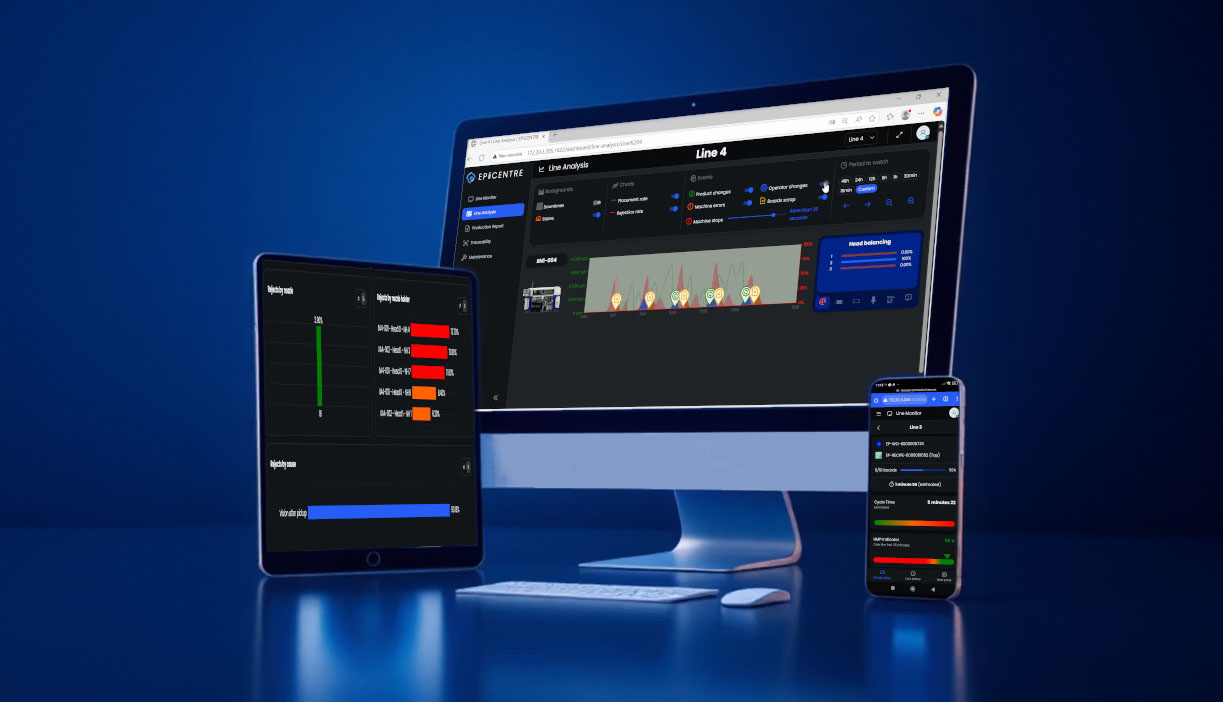
ii-TAB: putting the right tool in the right hands at the right moment
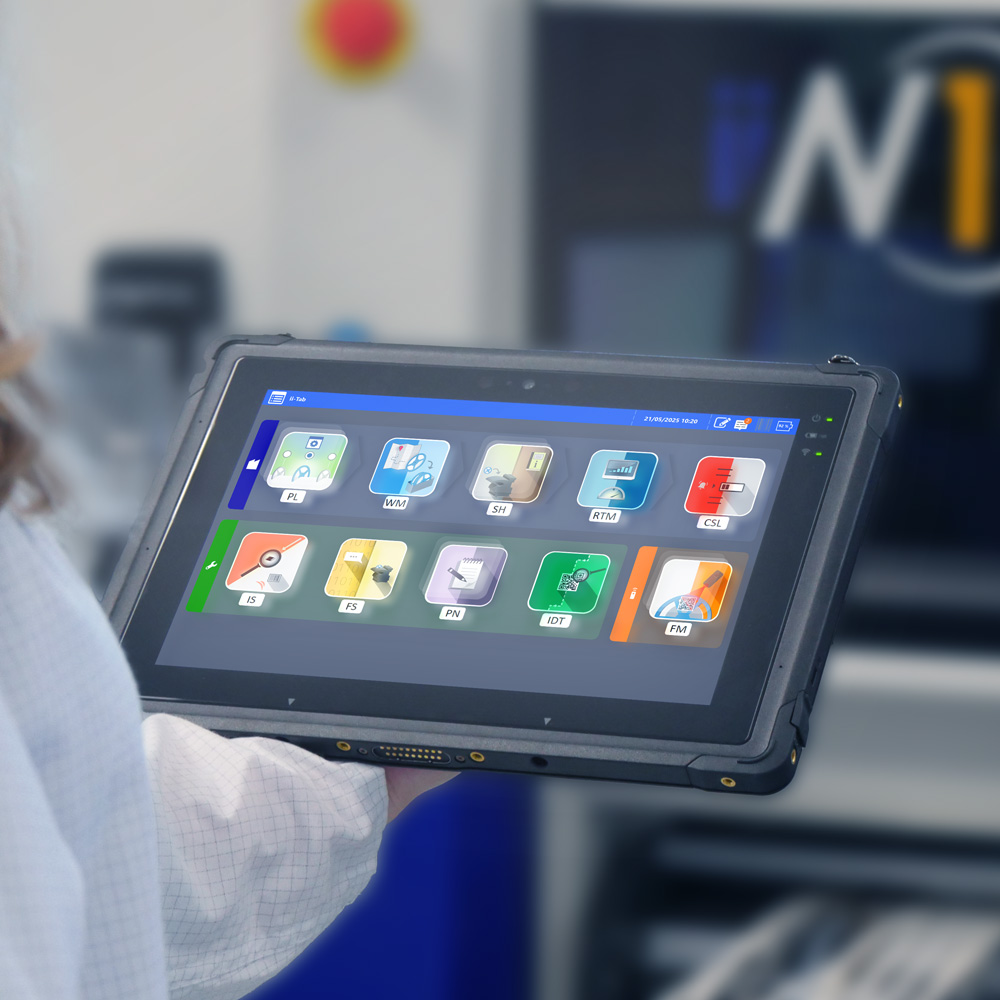
While EPiiCENTRE provides overall environment supervision, the ii-TAB applications from Europlacer embody another dimension of the data-driven strategy: putting data in the hands of those who need it, when they need it.
Designed for shop-floor use, the ii-TAB applications draw on the IPC CFX flow to provide operators, technicians and line managers with simple, contextualised and actionable interfaces. They cover in particular:
- Setup verification and step-by-step guidance during changeovers.
- Real-time material tracking: reel location, consumption alerts, MSD expiry management.
- Alerts and notifications triggered by machine events or performance thresholds.
- Operation validation by operators, thus creating a complete loop between human action and the data system.
By integrating the operator dimension into the IPC CFX data flow, ii-TAB closes the loop between machine and human and between the shop floor and the business. Data no longer flows only from equipment: it emerges from the entire production environment, including the human actions and decisions that form an essential part of shop-floor reality and overall performance.
End-to-end traceability: from reel to finished board, without chain breaks
The Hermes + IPC CFX combination finds one of its most powerful expressions in end-to-end traceability one of the most demanding challenges in high-mix manufacturing.
Firstly, Hermes ensures that the physical identity of every board is never lost as it travels through the line. IPC CFX enriches this identity at every step with contextual production data. Together, they enable the building of a continuous traceability chain, covering:
- Material intake: reference, manufacturer lot, stock entry date, initial quantity.
- Reel movement: from goods receipt to the warehouse, from warehouse to the line, from feeder to placement.
- Component-by-component consumption: which component was placed on which board, at which position, by which head, at which moment.
- Printer consumption: what paste, stencil, squeegee and all print parameters, were used on which board.
- Quality events: rejects, withdrawals, rework, SPI and AOI inspection results correlated with printer and placement data.
- Lot closure: actual vs. theoretical consumption, stock reconciliation, variance alerts.
In particular, this level of traceability matters most in demanding industries such as aerospace and defence. There, manufacturers must guarantee complete product genealogy, ensure regulatory compliance, and deliver rapid root-cause analysis when a quality issue arises.
In these environments, traceability is not merely a regulatory compliance tool or a customer reporting mechanism. The data-to-business dimension of IPC CFX turns it into a strategic management instrument. Manufacturers learn precisely what they produced, with which materials, under which conditions and on which equipment. From there, they draw operational lessons, tighten process control and keep improving manufacturing quality.
A two-level complementarity: the foundation of SMT connectivity according to Europlacer
Europlacer’s Industry 4.0 connectivity strategy therefore rests on a clear architecture, with two complementary and inseparable levels:
Hermes machine to machine: the physical and identity layer. It ensures that the line reliably recognises, transmits and receives every board between each piece of equipment, whatever the supplier. Hermes is the continuity of flow; the certainty that the line captures the physical reality of production without loss or ambiguity.
IPC CFX data to business: the semantic and decision-making layer. It transforms every production event whether from a machine, an operator or a material into structured information, usable by business systems and operational teams. IPC CFX is the intelligence of the line the ability to understand, analyse and steer production on the basis of facts, not intuitions.
This complementarity forms the true foundation of Industry 4.0 according to Europlacer. It delivers total connectivity, from the physical movement of the board to the business decision, with no breaks, no loss of information and no dependency on a closed ecosystem.

An adaptive strategy, suited to every stage of maturity
At Europlacer, we know that High-mix manufacturers do not all start from the same point. Some begin with a partially connected line. Others already have a MES and are looking to feed it with reliable shop-floor data. Others still wish to initiate a traceability approach on their most critical products.
Because of this, the Europlacer strategy is designed to adapt to each of these situations. Because Hermes and IPC CFX are open and extensible standards, because EPiiCENTRE is a modular platform, and because the ii-TAB applications can be deployed progressively, Industry 4.0 according to Europlacer is not an all-or-nothing project.
It is built step by step, delivering value at every level from simple line visibility to full component traceability, through changeover optimisation and data-driven productivity steering.
Conclusion: data as a lasting competitive advantage
In a market where quality, flexibility and responsiveness requirements are constantly growing, the ability to intelligently exploit production data is no longer a differentiator it is a condition for competitiveness.
Europlacer has chosen to build its Industry 4.0 offering on open, interoperable foundations centred on operational value: Hermes for machine-to-machine continuity, IPC CFX for transforming data into business intelligence, EPiiCENTRE to aggregate and deliver this intelligence, and ii-TAB to make it accessible and actionable on the shop floor.
Data-driven production is the ability to transform every production event whether from a machine, an operator or a material into useful information, at the right moment, for the right decision. This is Europlacer’s vision and commitment to Industry 4.0.
Next Steps
Want to find out how Europlacer can help deliver high-mix manufacturing to your facility? Contact us to have a discussion today.

September 21, 2026
In high-mix, low-volume production, a product may not be built again for months or even years, and batches are often too small to recover from a drifting process. For aerospace, defence and medical manufacturers, that makes every manual adjustment at the printer a direct cost to both capacity and quality. This article looks at how automated calibration, controlled squeegee pressure, closed-loop SPI and built-in traceability remove those variables from the first stage of the SMT line.
Find out why a stable print is the foundation of a predictable HMLV line.
July 13, 2026
In High Mix electronics manufacturing, the first board off the line is no longer just a setup step - it's where margin is won or lost.
Discover why First Board Right, powered by Europlacer's Process Integrity and Production Integrity, is becoming one of the most important economic levers in SMT production.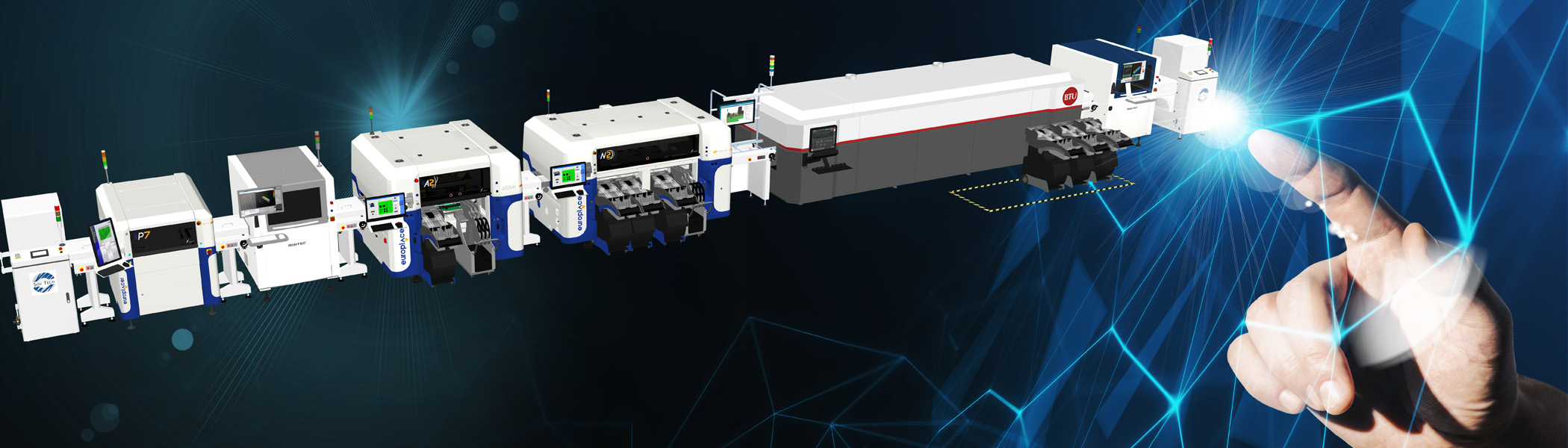
June 2, 2026
The real challenge of Industry 4.0 isn't generating more data, it's turning it into decisions you can act on. Europlacer's strategy builds on two complementary standards: Hermes for machine-to-machine continuity, and IPC CFX for transforming production events into business intelligence.
Discover how Hermes, IPC CFX, EPiiCENTRE and ii-TAB all connect the shop floor to the business, from the physical movement of every board to the decisions that drive productivity.